Why do we need more housing in Hullavington?
Many residents understandably ask why Hullavington needs more housing, particularly after the amount of development the village has already seen in recent years.
The answer lies in how the planning system works:
- National Government sets housing requirements
- Wiltshire Council decides how those homes are distributed across the county through the Local Plan
- Hullavington’s NDP helps shape how any housing allocated to the village is delivered locally
Wiltshire Council is currently preparing a new Local Plan covering the period 2026–2041. National housing requirements have increased significantly since the previous plan was prepared, meaning Wiltshire is expected to plan for substantially more new homes than before.
Based on the information currently available, Hullavington is expected to accommodate around 120 new homes during that period. However, the final figure will not be confirmed until Wiltshire Council adopts its new Local Plan.
Because that may still be several years away, the Steering Group commissioned an independent Housing Topic Paper to estimate the most likely housing requirement using the best evidence currently available. This considered factors such as local demographics, affordability, school rolls, household size, housing need and the changing age profile of the parish.
The purpose of the Neighbourhood Development Plan is therefore not to decide how many homes Hullavington should have, but to ensure that if new homes are required, they are built:
- in the most appropriate locations
- with the right mix of housing
- alongside the infrastructure the village needs; and
- with lasting benefits for the whole community
| The number of homes is determined through Wiltshire’s Local Plan. The Neighbourhood Development Plan helps the community influence where those homes go, what they look like and what benefits they bring. |
How has the NDP come up with the proposed number of new homes?
The final housing requirement for Hullavington will be confirmed through Wiltshire Council’s new Local Plan, which is still being prepared, and may take several years before it is completed and approved. Because that process is not yet complete, the NDP is using the best information currently available so the village is prepared, rather than waiting until decisions have already been made elsewhere. The current best estimate of the net new houses required from Hullavington during the period of this updated NDP i.e. 2026-2041 is 120 homes.
What happens if Hullavington doesn’t have an up-to-date Neighbourhood Development Plan?
Stopping or delaying the NDP will not stop development.
In fact, it is likely to reduce the village’s influence over where development takes place and what it delivers.
Normally, the strongest planning protection comes from having:
- an up-to-date Local Plan
- an agreed housing requirement
- a demonstrable five-year housing land supply
At present, Wiltshire’s Local Plan has been withdrawn, a replacement is still being prepared, and the Council cannot currently demonstrate a five-year housing land supply. This means national planning policy is more likely to favour housing proposals unless there are strong reasons for refusal.
Without an up-to-date Neighbourhood Development Plan, developers may find it easier to promote additional sites or submit speculative planning applications.
A Neighbourhood Development Plan cannot prevent all development, but it provides robust, community-backed evidence showing:
- which sites have been assessed
- where development should be directed
- what scale of development is appropriate
- what infrastructure is required
- what environmental and community benefits should be delivered
Without that evidence, more of those decisions are likely to be made through planning appeals rather than local planning. The parish would also normally receive a lower proportion of Community Infrastructure Levy (CIL) funding from future development.
The choice is therefore not between development and no development. It is between shaping future growth ourselves or leaving more of those decisions to others.
How many homes are expected, and could that change?
The Steering Group currently estimates that Hullavington may need to accommodate around 120 new homes between 2026 and 2041. This figure is based on the best information currently available and may change as Wiltshire Council prepares its new Local Plan.
The final requirement could increase or decrease before the Local Plan is adopted.
Some homes that already have planning permission but have not yet been completed may count towards any future requirement. The Steering Group is working with Wiltshire Council to clarify exactly how existing commitments will be treated.
At this stage, the figure should be seen as the best available estimate rather than a final target.
The Steering Group will continue to update residents as more information becomes available.
What is a Call for Sites?
A Call for Sites is an early stage of the Local Plan process. It invites landowners, developers and site promoters to suggest land that could potentially be developed in the future.
Submitting land through a Call for Sites:
- does not grant planning permission
- does not mean a site is suitable for development
- does not mean Wiltshire Council has selected the site
However, it is still an important stage because sites submitted through the process become part of the evidence considered during preparation of the Local Plan. For Hullavington, this means previously rejected sites, as well as new sites, may be promoted again by developers.
That makes completing the Neighbourhood Development Plan even more important, as it provides Wiltshire Council with a clear, evidence-based assessment of which sites are most appropriate for the village and why.
How were the proposed development sites selected?
The Steering Group wanted the assessment process to be as fair, transparent and evidence-based as possible.
All known landowners with land adjoining the village were invited by the Steering Committee to submit sites if they wished them to be considered. In addition, other potentially suitable sites were also assessed, even where landowners had indicated they had no intention of developing.
Not every landowner wished to promote their land for development. While some potentially suitable sites were identified and assessed as part of the evidence base, only sites that were both suitable in planning terms and capable of being brought forward within the Plan period could realistically be considered for allocation.
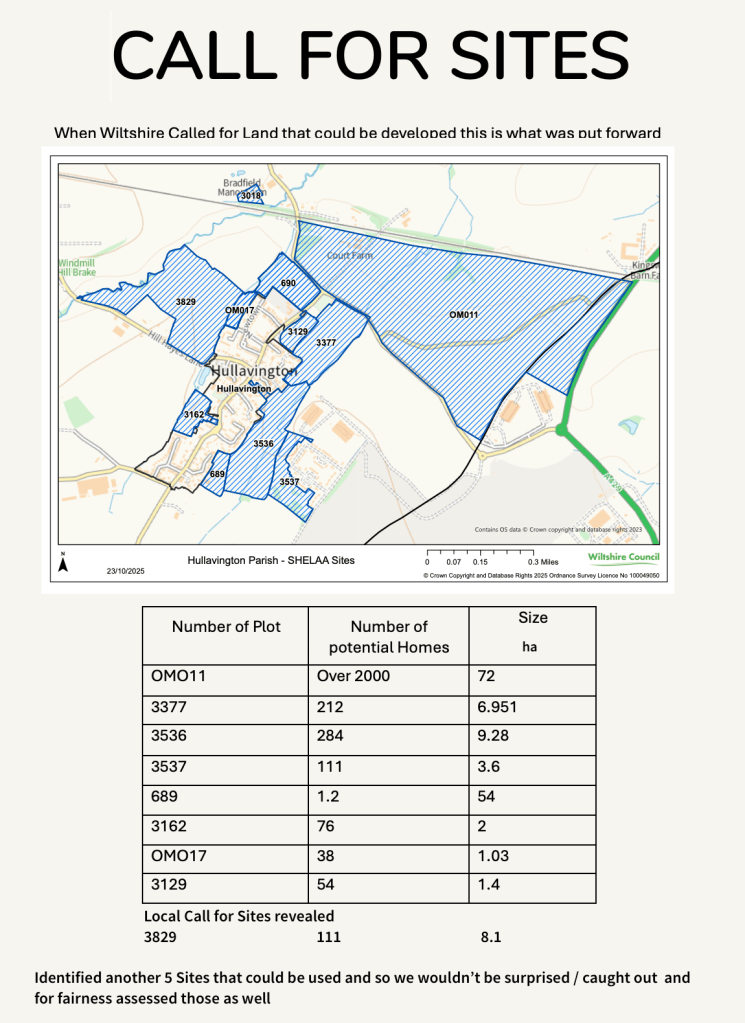
Every site was assessed using Wiltshire Council’s site assessment methodology and considered against a wide range of planning, environmental and community criteria, including:
- landscape impact
- flood risk
- ecology
- highways and access
- heritage
- relationship to the existing village
- deliverability
- ability to provide wider community benefits
The assessments built upon the professional work carried out for the previous Neighbourhood Plan and were reviewed by Steering Group members with relevant professional expertise.
Following this process, two sites emerged as the preferred options because they best balanced the anticipated housing requirement with the opportunity to deliver wider benefits for Hullavington.
Further details of the assessment process, including why other sites were not selected, will be published alongside the draft Plan.
| Every site was assessed using exactly the same methodology. The aim was to identify the locations that could best meet the village’s future needs while protecting what residents value most about Hullavington. |
What types of homes are being planned?
One of the key aims of the Neighbourhood Development Plan is not simply to build more homes, but to build the right homes.
Research shows that Hullavington has an ageing population and a high proportion of larger homes occupied by smaller households. Many younger people and families also struggle to find suitable housing locally. The Plan therefore seeks to encourage a better mix of housing, including:
- affordable homes for local people and first-time buyers
- homes suitable for older residents wishing to downsize
- family homes
- a range of property sizes and types rather than predominantly large executive houses
The exact mix will ultimately be determined through future planning applications and Wiltshire Council’s planning policies, but the Neighbourhood Development Plan provides a clear indication of the community’s priorities. A balanced housing mix helps people stay in Hullavington throughout different stages of life while supporting local services such as the school, shop and other community facilities.
What benefits could new development bring?
If development takes place, the Neighbourhood Development Plan aims to ensure that it leaves a lasting positive legacy for Hullavington. Potential benefits include:
- additional Community Land for the whole village
- enhanced biodiversity
- improved walking, cycling and riding routes
- homes better suited to local needs
- support for local facilities such as the school and village shop
- wider infrastructure improvements
| The Neighbourhood Development Plan gives Hullavington the strongest possible platform to secure community benefits, while being honest about what it can and cannot guarantee. |
What’s the difference between ‘Community Land’ and ‘Public Open Space’?
Although both may include green space, they serve different purposes.
Public Open Space is the green space that every new housing development is normally required to provide for the people who will live there. It might include children’s play areas, small parks, landscaped areas or informal open space within the development. It is a standard planning requirement and is designed to meet the needs created by that particular development.
Community Land is additional land secured through the Neighbourhood Development Plan for the benefit of the whole village. Rather than serving just one new housing development, it is intended to create long-term community assets that everyone in Hullavington can enjoy.
Depending on the final design, Community Land could include:
- larger accessible green spaces
- wildlife habitats and biodiversity improvements
- walking and cycling routes
- natural flood management
- recreation areas
- land for future community facilities
Importantly, Community Land is not being counted as the Public Open Space required for the housing development. Each development will still be expected to provide all of the public open space, play areas, drainage, biodiversity improvements and other infrastructure required by planning policy.
Hullavington has historically had relatively little community-owned land. The aim of the Neighbourhood Development Plan is therefore to ensure that, if the village grows, it also gains lasting community assets that benefit everyone, not just the residents of the new development.
 Hullavington Village